
Welcome to the MyCash Dashboard on measuring volunteering from a cash perspective to strengthen an organisation. Volunteering is a cornerstone of the not-for-profit (NFP) sector providing essential services and enriching communities. Volunteering contributes significantly socially and economically. This whitepaper aims to help not-for-profits measure the impact of volunteering and develop a strategic approach to measure the cash impact.

Myth busting
It is a myth that volunteers are difficult to find. Studies show one in four people undertook formal volunteering (through organised programs or organisations) and this increases to more than one in two when informal volunteering (helping friends and neighbours) is included. However, it is true that many organisations are poor at volunteer recruitment and management.
The Value of Volunteering
Volunteers are the lifeblood of many organisations, offering time, skills, and enthusiasm. Beyond the tangible services they provide, volunteers help foster community engagement, reduce social isolation, and enhance the overall quality of life. For not-for-profits, volunteers can significantly reduce operational costs and increase organisational capacity.

“Give a man a fish, and you feed him for a day. Teach a man to fish, and you feed him for a lifetime”.
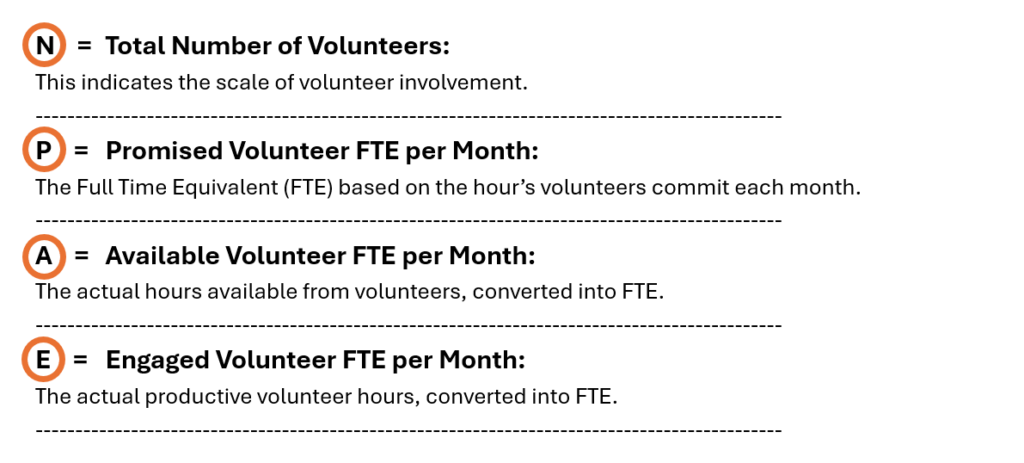
Measuring Volunteering Effort – NPAE
Accurate measurement of volunteering efforts is crucial for understanding and maximising their impact. Managing the following metrics have proven to work.
Applying the metrics
Assumptions
- Assume a NFP needs to find $180,000 to break even.
- Assume the fiscal benefit of a full time equivalent (FTE) volunteer is ~$60,000. The NFP needs three volunteer FTEs to break even.
- One day = 8 hours work
- One FTE = 40 hrs x 50 weeks = 2,000 hours per year (rounded to 167 hours per month)
A typical NFP to achieve the above
“N” – the number of volunteers is 20

“P” – Promised time by Volunteers
10 volunteers promise one day per week and 10 promise ½ day per week
= (10 x 8hrs x 50wks) + (10 x 4hrs x 50 weeks)
= 4,000 hours pa + 2,000 hours pa
= 6,000 hours pa
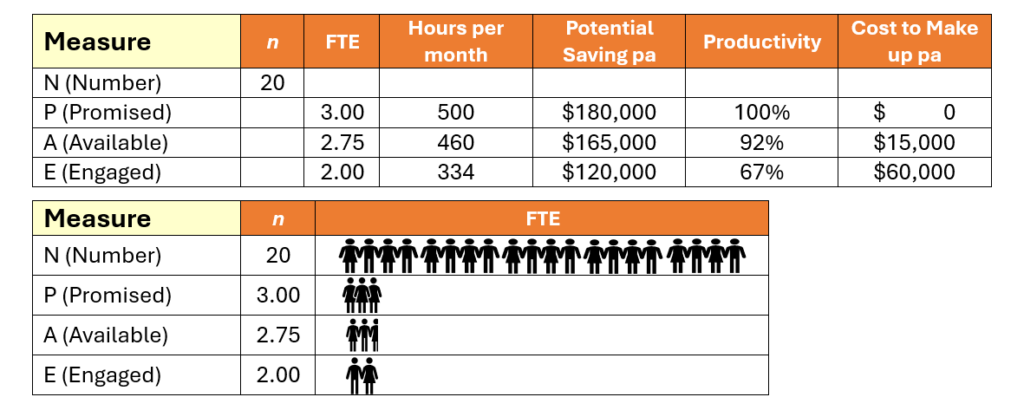
= 3.0 FTE (6,000hrs ÷ 2,000hrs; equivalent to 500 hours per month)
Anticipated organisation benefit = 3.0 FTE
= $180,000pa ($60,000 x 3.0 FTE; or $15,000 per month)

“A” – Available time by Volunteers
This month – five call in sick during for one day each (5 x 8hrs ea) = 40 hours
P (promised) = 500 hours per month
A (available) = 500 – 40 (sick hours) = 460 hours
Available FTE this month
=2.75 FTE

“E” – Engaged time by Volunteers
Organisational issues may impact ability to engage volunteers.
(vehicle availability is an example)
Engaged FTE/Hours this month.
Engaged hours = 2.0 FTE
= 334 hours in month
= 334 hours in month

Summary: Sample Management
Is it worth it?
- What is the cost of running a volunteer programme?
- What is the cost of not running a volunteer programme?
Our Recommendation: Aim for 75% in Engaged productivity
Recruitment Methods and Effectiveness
Now we know how to measure the volunteer effort there are specific strategies of the board and management to focus on at each stage.
Effective recruitment & retention is a result of a deliberate strategy in attracting and retaining volunteers. Understanding which methods work best can help optimise these efforts.
N (number)
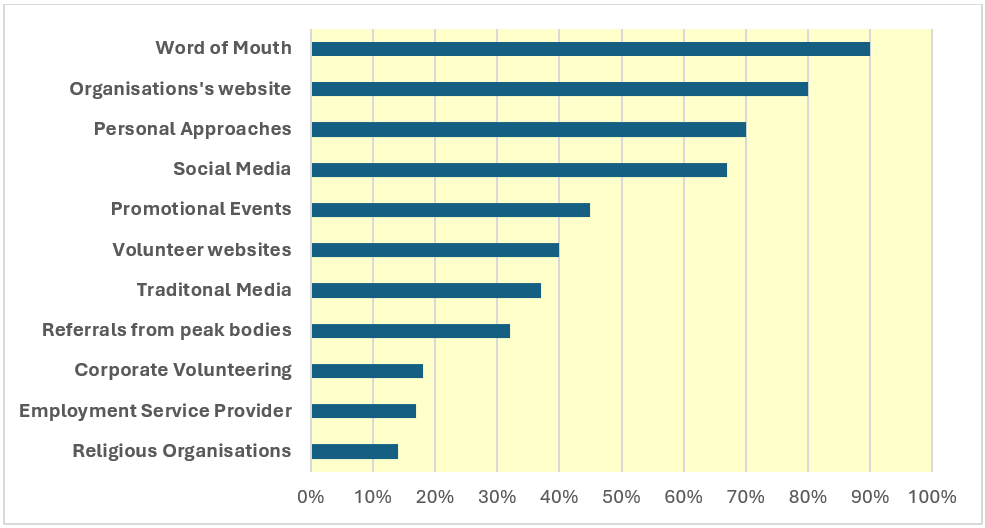
Growth & Retention –the largest category to secure volunteers plus the most effective is word of mouth (90%). Design a recruitment & retention programme.
When someone has the courage to call …
- Never send a form unless the potential volunteer asks for that process. Invite them to come to the office and start the process via a meet and greet. Fill the form(s) in with them.
- Thank them and welcome them in the first sentence. The first discussion is about them not your organisation. Show genuine interest in the person calling
- Ask, “Is there any particular activity that interests you?”
- Never send a form unless the potential volunteer asks for that process. Invite them to come to the office and start the process via a meet and greet. Fill the form(s) in with them.
- Never send a form unless the potential volunteer asks for that process. Invite them to come to the office and start the process via a meet and greet. Fill the form(s) in with them.
- Never send a form unless the potential volunteer asks for that process. Invite them to come to the office and start the process via a meet and greet. Fill the form(s) in with them.
P (promised time)
Communicate constantly, reward, survey satisfaction, survey culture.
A (available time)
Plan for absences, react to illnesses, create affinity, prove you care.
E (engaged time)
Plan for organisational disruptions. It doesn’t take much for disruptions to impact the jobs you request volunteers to do and the flow on impact in cash and future engagement
Top 10 Recruitment methods and approximate weighting
Developing a Volunteering Strategy
A well-defined volunteering strategy is crucial for maximising the social cash benefits of volunteering. Key elements of a successful strategy include:
- Clear Objectives
- Define what the organisation aims to achieve through its volunteer program.
- Targeted Recruitment
- Use data to identify and target potential volunteers who are most likely to be motivated by the organisation’s mission.
- Effective Training and Onboarding
- Ensure volunteers are well-prepared and supported in their roles.
- Ongoing Engagement
- Maintain regular communication and provide opportunities for feedback and development to keep volunteers engaged.
- Recognition and Reward
- Acknowledge and celebrate volunteer contributions to foster a positive and appreciative environment.
Summary
Volunteering provides substantial social and economic benefits, both for not-for-profits and the broader community. By accurately measuring volunteer efforts and developing a strategic approach, organisations can maximise these benefits. MyCash Dashboard can assist in tracking and analysing volunteer data, ensuring not-for-profits can make informed decisions and optimise their volunteer programs for greater social cash benefits.